Caravaggio (Milano, 1571 - Porto Ercole, GR, 1610)
The Great Artist's Biography is now available on-line
Category Artists' Biographies
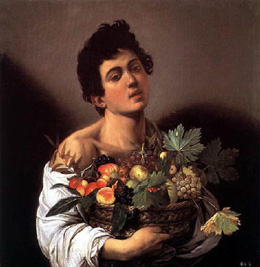
MICHELANGELO MERISI detto CARAVAGGIO (Milano, 1571 – Porto Ercole, Grosseto, 1610)
Caravaggio was an Italian baroque painter who was the best exemplar of naturalistic painting in the early 17th century. His use of models from the lower classes of society in his early secular works and later religious compositions appealed to the Counter Reformation taste for realism, simplicity, and piety in art. Equally important is his introduction of dramatic light-and-dark effects - termed chiaroscuro - into his works. Originally named Michelangelo Merisi, Caravaggio was born September 28, 1573, in the Lombardy hill town of Caravaggio, from which his professional name is derived. He may have spent four years as apprentice to Simone Peterzano in Milan before going to Rome in 1593, where he entered the employ of the Mannerist painter Giuseppe Cesari, also known as the Cavaliere d'Arpino, for whom he executed fruit and flower pieces (now lost). Among his best-known early works are genre paintings (scenes from everyday life) with young men - for example, The Musicians (1591?-1592, Metropolitan Museum, New York City) - which were done for his first important patron, Cardinal Francesco del Monte. Scenes such as the Fortune Teller (1594, versions in the Louvre, Paris, and the Museo Capitolino, Rome) were especially appealing to the artist's followers. Caravaggio's mature manner commenced about 1600 with the commission to decorate the Contarelli Chapel in San Luigi dei Francesi in Rome with three scenes of the life of Saint Matthew. The Calling of Saint Matthew (1599?-1600) is noted for its dramatic use of cellar light, streaming in from a source above the action, to illuminate the hand gesture of Christ (based on Michelangelo's Adam on the Sistine ceiling) and the other figures, most of whom are in contemporary dress. About 1601, Caravaggio received his second major commission, from Santa Maria del Popolo in Rome for a Conversion of Saint Paul and Crucifixion of Saint Peter. In the former, a bright shaft of light carries symbolic meaning, indicating the bestowal of Christian faith upon Saul. Caravaggio's personal life was turbulent. He was often arrested and imprisoned. He fled Rome for Naples in 1606 when charged with murder. There he spent several months executing such works as the Flagellation of Christ (San Domenico Maggiore, Naples), which were crucial to the development of naturalism among the artists of that city. Later that year he traveled to Malta, was made a knight, or cavaliere, of the Maltese order, and executed one of his few portraits, that of his fellow cavaliere Alof de Wignacourt (1608, Louvre). In October of 1608, Caravaggio was again arrested and, escaping from a Maltese jail, went to Syracuse in Sicily. While in Sicily he painted several monumental canvases, including the Burial of Saint Lucy (1608, Santa Lucia, Syracuse) and the Raising of Lazarus (1609, Museo Nazionale, Messina). These were multi-figured compositions of great drama achieved through dark tonalities and selective use of lighting. These works were among Caravaggio's last, for the artist died on the beach at Port'Ercole in Tuscany on July 18, 1610, of a fever contracted after a mistaken arrest. Although the use of both realistic types and strong chiaroscuro originated in northern Italian art of the previous century, Caravaggio brought new life and immediacy to these aspects of painting, with which he effected a transformation of anticlassical Mannerism in early baroque Rome. Despite his personal protestations that nature was his only teacher, Caravaggio obviously studied and assimilated the styles of the High Renaissance masters, especially that of Michelangelo. Caravaggio's impact on the art of his century was considerable. He discouraged potential students, but throughout the century a naturalist school flourished in Italy and abroad based on an enthusiastic emulation of his style.
|